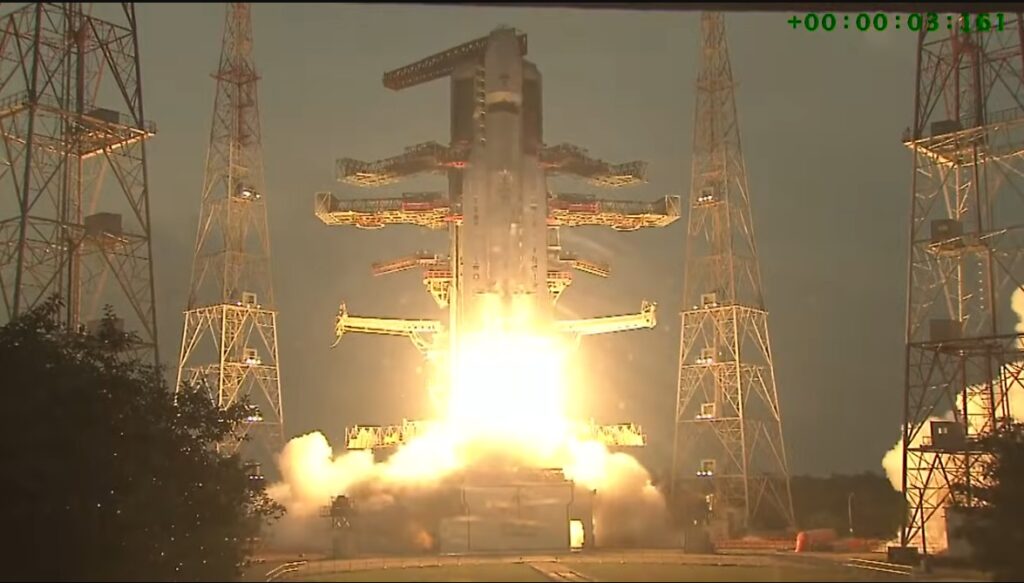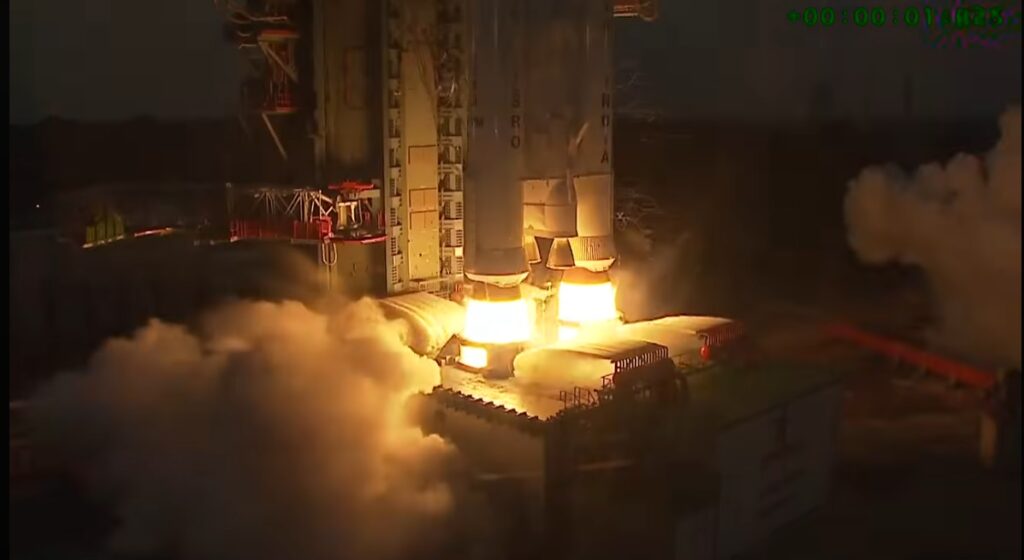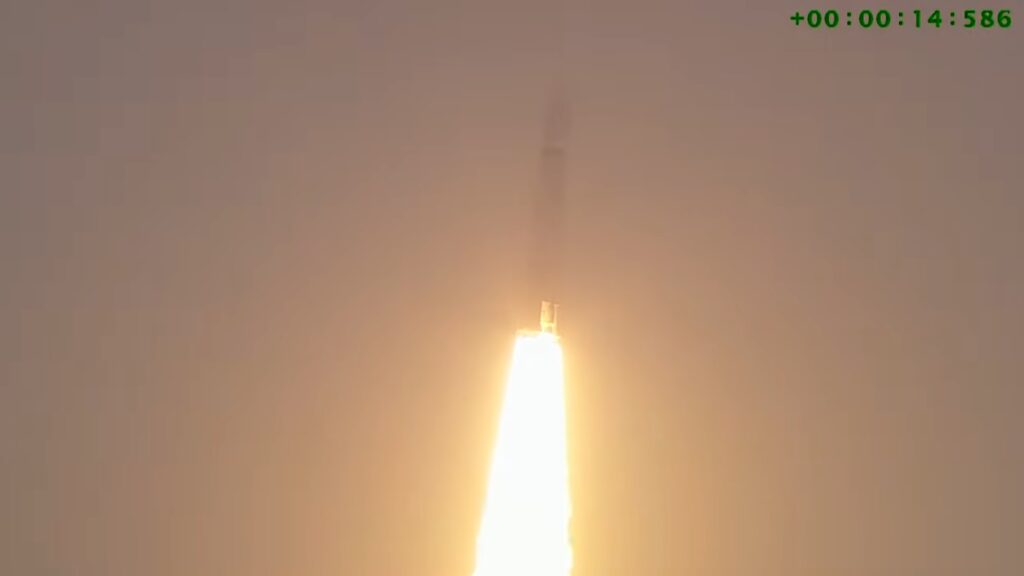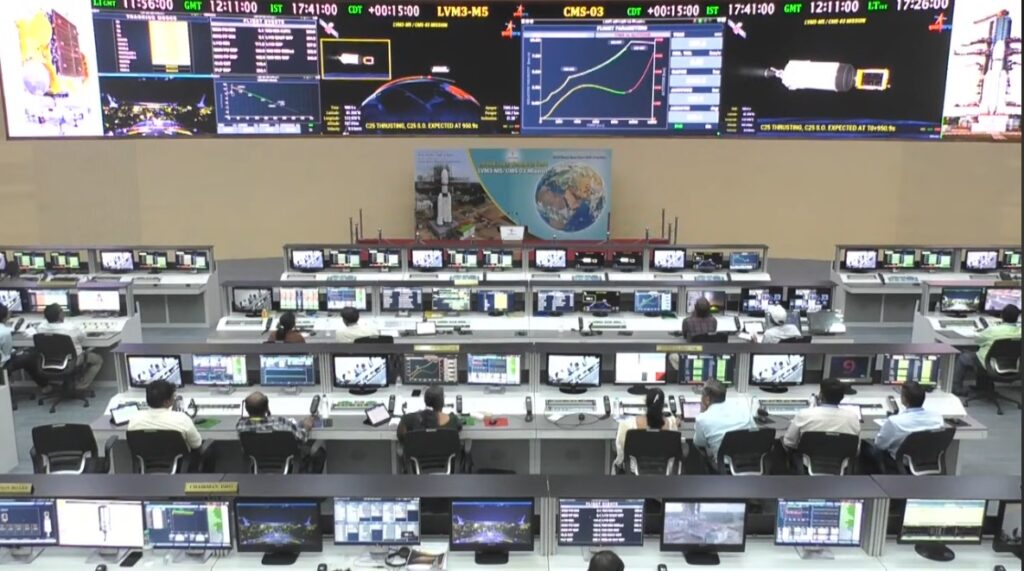

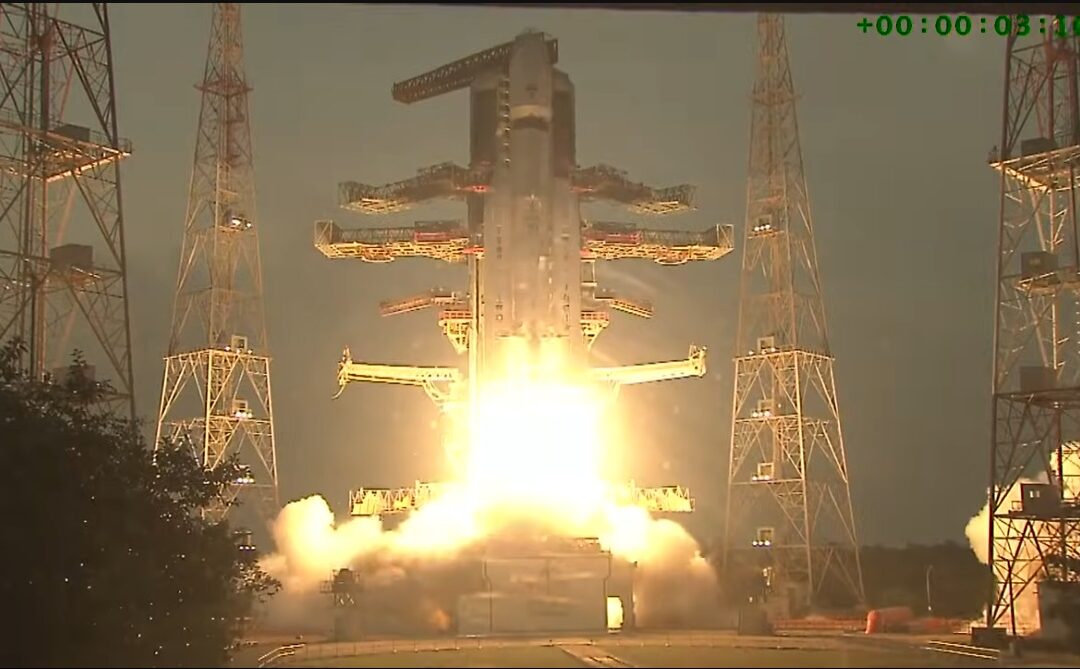
Sriharikota, November 2, 2025 — The Indian Space Research Organisation (ISRO) achieved another major milestone today with the successful launch of CMS-03, India’s heaviest home-built communication satellite, aboard the LVM3-M5 heavy-lift launch vehicle. The mission lifted off from the Second Launch Pad of the Satish Dhawan Space Centre (SDSC), Sriharikota, at 17:26 IST, marking a proud moment in India’s growing space capabilities.
The Launch and Orbit Insertion
Designated LVM3-M5, this was the fifth operational flight of ISRO’s most powerful launcher, often nicknamed “Bahubali” for its lifting strength. The three-stage vehicle, comprising two S200 solid strap-on boosters, a liquid core stage (L110), and an upper cryogenic stage (C25), flawlessly executed its mission profile.
Approximately 16 minutes after liftoff, the CMS-03 satellite was injected into a Geosynchronous Transfer Orbit (GTO). Over the coming days, the satellite’s onboard propulsion system — the Liquid Apogee Motor (LAM) — will perform a series of orbit-raising maneuvers to position CMS-03 into its final Geostationary Orbit (GEO), roughly 36,000 kilometers above Earth.
CMS-03: A Strategic Communication Asset
Weighing around 4,410 kilograms, CMS-03 is the heaviest Indian communication satellite ever launched from Indian soil. The satellite is designed to enhance and secure communication links for India’s defense and maritime sectors, with a primary focus on supporting the Indian Navy’s operational communications.
Built by ISRO’s U R Rao Satellite Centre (URSC) in Bengaluru, CMS-03 is equipped with multi-band transponders covering UHF, S, C, and Ku bands, providing robust voice, data, and video connectivity across India’s landmass and its extensive maritime zones, including the Indian Ocean Region. The system ensures seamless, encrypted communication between naval ships, submarines, aircraft, and command centers, strengthening India’s strategic communication network.
Technological and Strategic Significance
The LVM3-M5 mission underscores ISRO’s ability to independently place heavy payloads into GTO — a domain once dominated by foreign launchers. The LVM3, which previously demonstrated reliability through Chandrayaan-3 and OneWeb missions, now adds a key defense communication mission to its legacy.
By launching CMS-03 domestically, India reaffirms its self-reliance in satellite launch capabilities and indigenous space infrastructure. The success also aligns with the government’s vision of “Aatmanirbhar Bharat in Space,” ensuring secure and sovereign communication for the nation’s armed forces.
Voices of Pride and Future Prospects
Congratulating the ISRO team, Prime Minister Narendra Modi hailed the mission as a “significant stride in India’s pursuit of space self-reliance and secure communications,” praising the scientists for delivering yet another record-breaking performance.
ISRO Chairman S. Somanath expressed satisfaction with the mission’s precision, noting that the “LVM3 platform continues to perform at world-class standards.” He emphasized that CMS-03’s deployment showcases India’s capability to build and launch satellites weighing over four tonnes into GTO — a key threshold for global communication satellite operations.
A Foundation for the Future
With CMS-03 now safely in orbit, ISRO will conduct detailed in-orbit checks before the satellite begins full-scale operations. Once operational, CMS-03 will serve as the primary communication hub for the Indian Navy and other strategic users, significantly improving real-time situational awareness and coordination across India’s maritime theater.
The success of LVM3-M5 also sets the stage for upcoming missions, including LVM3-M6, expected later this year, which will continue to expand India’s launch capabilities. Moreover, the proven reliability of LVM3 positions it as the core vehicle for Gaganyaan, India’s first human spaceflight program.
Mission Highlights at a Glance
| Parameter | Details |
|---|---|
| Launch Vehicle | LVM3-M5 (Launch Vehicle Mark-3) |
| Launch Site | Satish Dhawan Space Centre, Sriharikota |
| Launch Time | 17:26 IST, November 2, 2025 |
| Payload | CMS-03 Communication Satellite |
| Payload Mass | ~4,410 kg |
| Orbit | Geosynchronous Transfer Orbit (GTO) |
| Satellite Purpose | Secure communications for Indian Navy and strategic users |
| Developed By | ISRO’s U R Rao Satellite Centre (URSC), Bengaluru |
| Orbit-Raising | Using onboard Liquid Apogee Motor (LAM) |
| Next Mission | LVM3-M6 (Planned for December 2025) |
Conclusion
The LVM3-M5/CMS-03 mission stands as a landmark achievement, showcasing India’s mastery of heavy-lift launch systems, indigenous satellite design, and strategic communication capability. With this success, ISRO not only strengthens the nation’s defense infrastructure but also reinforces its reputation as a leading spacefaring nation — poised for even greater achievements in the years ahead.